DRX9000 vs. Other Spinal Decompression Tables: What's the Difference?
How the DRX9000 compares with Triton decompression tables, standard traction and inversion tables, and how Dr. Ryan Alter picks the right one for your spine.
Chiropractic Care · October 27, 2026
Short answer: every spinal decompression table gently stretches the spine to take pressure off discs and nerves. The DRX9000-SL is an advanced decompression system whose computer adjusts the pull many times a second and can target specific disc levels. Other tables, like the Triton, are dependable everyday options. Both of ours treat the neck and the low back, and the best table is the one that fits your exam findings.
If you’ve been searching for help with a herniated disc or sciatica, you’ve probably run into a lot of names: DRX9000, Triton, DTS, “decompression table,” even inversion tables. They can sound interchangeable, and the marketing around them doesn’t always help. At Alter Chiropractic in Delray Beach, we use two of these systems every day, so here is a plain-language guide to how they differ and how we decide which one you need.
What every decompression table has in common
Non-surgical spinal decompression is a form of computer-controlled traction. You lie on a padded table, straps or a harness hold you in place, and a motor gently pulls and relaxes in slow cycles. The goal is to ease pressure on irritated discs and the nerves around them, so the area has a better chance to calm down and heal.
A few things are true of every good decompression system:
The pull is gradual. The table ramps up slowly instead of yanking, so the muscles around the spine don’t tense up and fight it.
It cycles. Periods of stretch alternate with periods of rest. That pull-and-relax rhythm is what separates decompression from simply hanging or lying in traction.
It’s set for you. The amount of pull, the angle and the length of the session are adjusted to your body and your problem.
It’s part of a plan. Decompression works best alongside care that keeps the spine moving, such as adjustments and simple home exercises.
So the differences between machines are not about whether they “decompress.” They’re about how the pull is delivered, which parts of the spine the table can treat, how you are positioned, and how precisely the system adjusts during the session.
What makes the DRX9000 different
The DRX9000 is made by Excite Medical in Tampa, Florida. It was originally developed by Axiom Worldwide, also in Tampa, and was cleared by the FDA in 2006 as the “DRX9000 True Non-Surgical Spinal Decompression System.” The clearance covers low back pain and sciatica linked to herniated discs, bulging or protruding discs, degenerative disc disease and posterior facet syndrome.
Here is what sets it apart:
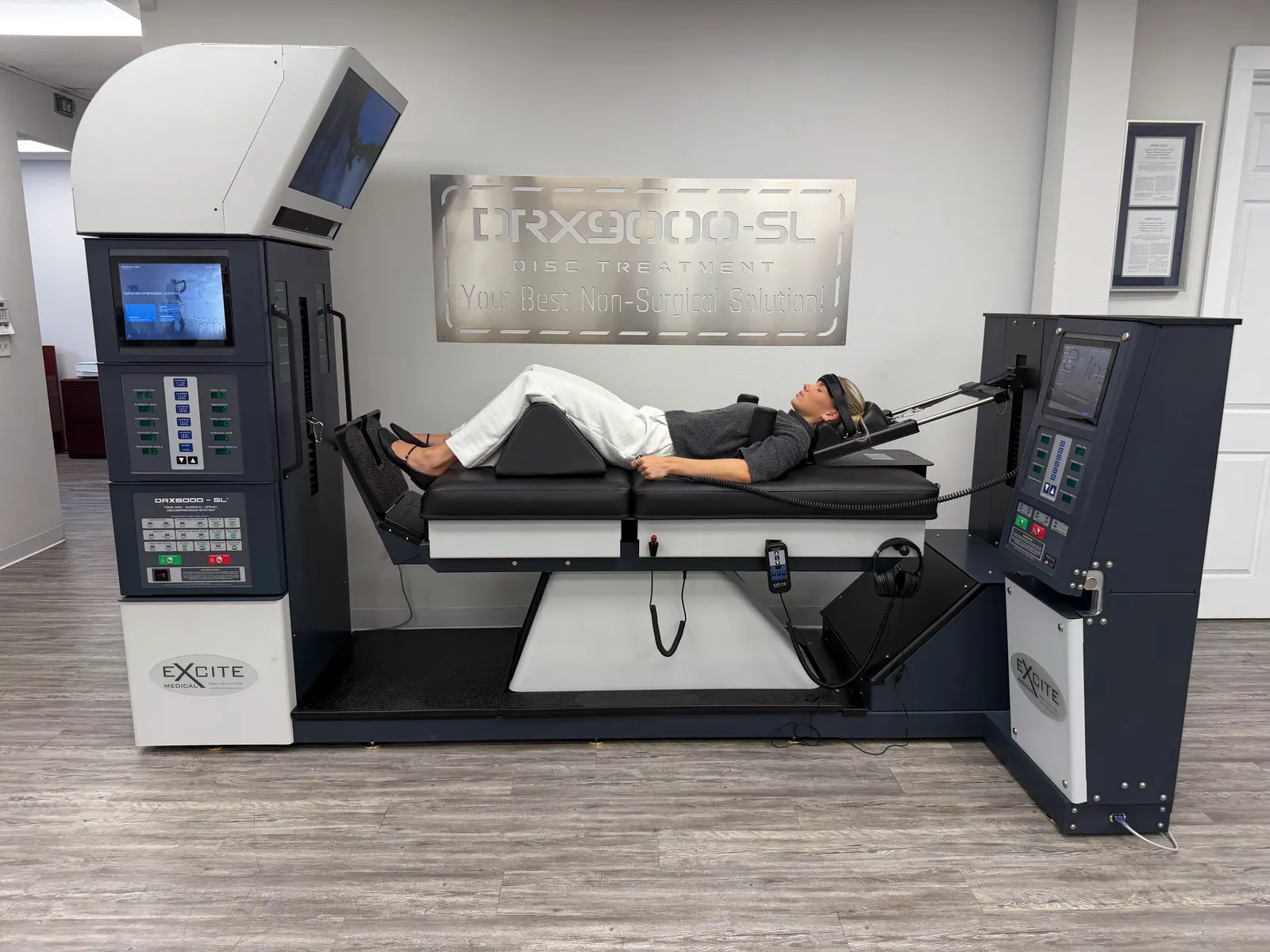
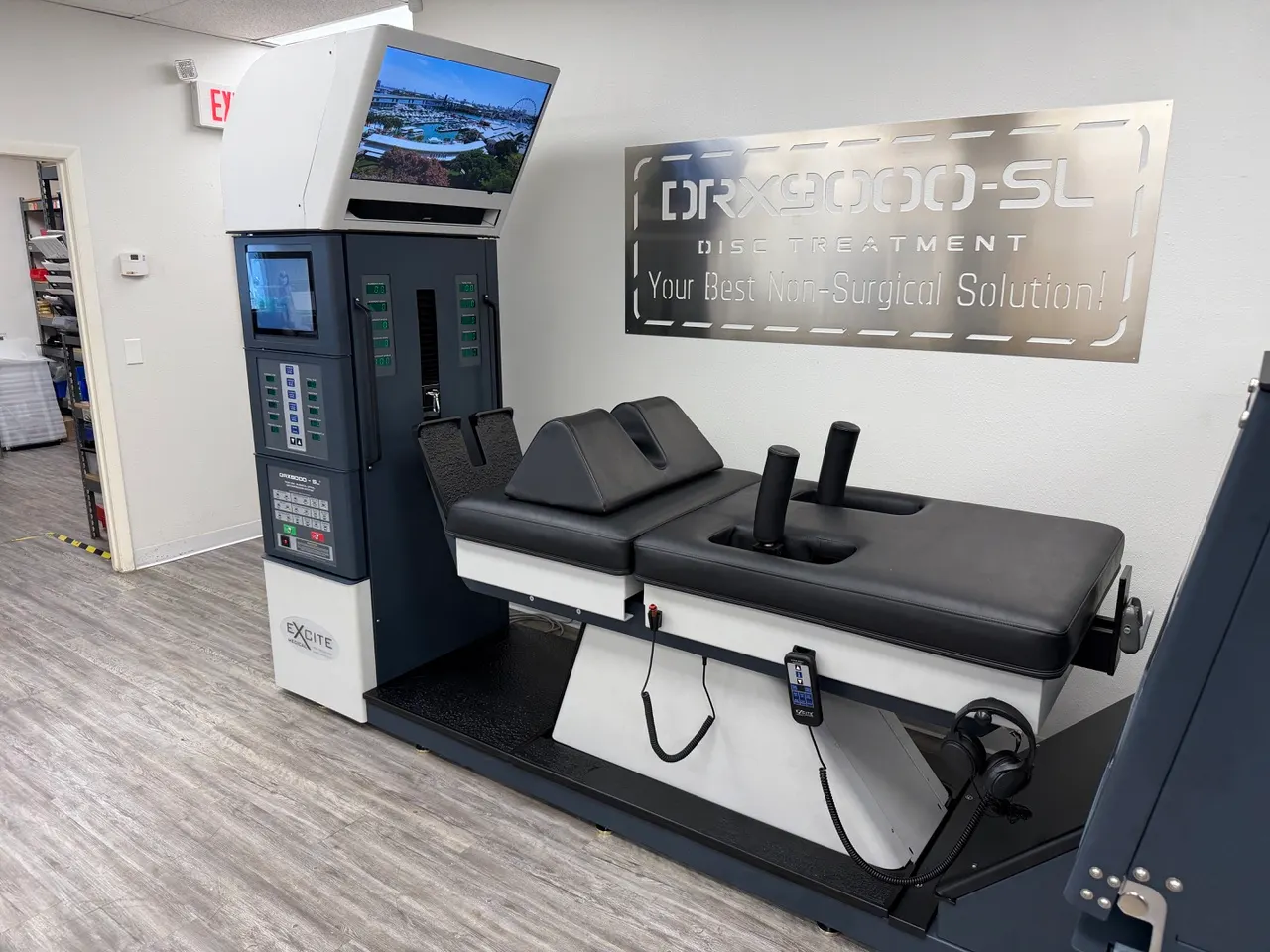
Built for decompression. The DRX9000 is a purpose-built decompression system rather than a general traction unit. The DRX9000-SL, the current model and the one in our office, treats both the low back and the neck.
How you’re positioned. You lie on your back. For the low back, an upper body harness and a belt hold you in place, and the lower part of the table moves with the pull. For the neck, a padded harness cradles your head.
A computer that keeps adjusting. According to Excite Medical, the motor makes up to 100 small adjustments per second, responding to how your body reacts instead of running one fixed setting from start to finish.
The SL treatment curve. A gradual, wave-like pull designed to keep your muscles from tensing up and fighting the stretch.
Disc-level targeting and memory. The table can change its angle of pull to focus on specific disc levels, and it remembers your settings from visit to visit.
Patient controls. The system includes a safety switch you hold during treatment, so you can stop a session at any time.
At our office, a DRX9000-SL session lasts about 20 to 25 minutes, and a typical plan is about 24 sessions over 6 to 12 weeks. Dr. Alter sets your exact plan after your exam.
What the Triton tables do well
Our Chattanooga Triton tables are computer-controlled traction and decompression systems too, and they do a lot of patients a lot of good. Their big strength is range:
Neck and low back. The same system treats the neck with a cervical attachment and the low back with a lumbar harness. Many of our patients do very well on it, for both neck and back problems.
Very adjustable. Pull strength, hold and rest times, and angles can all be tuned for each patient.
Proven in our office. The Triton tables have been part of our decompression care for years, and many of our patients have done very well on them.
Choosing the DRX9000 for a patient isn’t a knock on the Triton. They’re two good tools with different strengths.
DRX9000 vs. Triton at a glance
DRX9000
Triton
Area treated
Neck and low back
Neck and low back
Design
Purpose-built, advanced decompression system
Versatile traction and decompression system
Positioning
On your back, with a neck or low back harness
On your back, with a neck or low back harness
Adjustment during a session
Up to 100 adjustments per second, disc-level targeting
Settings tuned for each patient
Session length in our office
About 20 to 25 minutes
Varies by plan
Often recommended for
Avoiding surgery, failed past treatment, active people
Many everyday neck and back cases
How Dr. Alter chooses a table for you
You don’t need to decide which machine you want. At your visit, Dr. Alter looks at:
Where the problem is. Both tables treat the neck and the low back, so this is about which level of the spine is involved.
What your exam and X-rays show. Which level of the spine is involved, how irritated the nerve is, and how long the problem has been going on all matter.
Your history. What you’ve already tried, and how your back has responded, helps shape the plan.
How you respond. Comfort and progress over the first visits guide any changes.
Dr. Alter often recommends the DRX9000-SL, our most advanced system, for people trying to avoid spinal surgery, people whose other treatments haven’t worked, and active people who want every possible advantage. For many other patients, the Triton is exactly the right tool. Either way, you’ll know which table you’re on and why before your first session.
What about other “decompression” options?
Inversion tables. Hanging upside down also stretches the spine, but it can’t target one level, it isn’t controlled or monitored, and it isn’t safe for people with high blood pressure, glaucoma or heart problems. Dr. Alter compares the two in his inversion table vs. spinal decompression table episode.
Standard traction. Older traction tables pull with a constant force rather than in controlled cycles. They can help some patients, but they don’t adjust to your body the way modern decompression systems do.
Intersegmental traction. The rolling tables you may see in our office are not decompression. Intersegmental traction gently moves the spine one segment at a time to loosen stiff joints, and it’s often part of the same plan.
Will a doctor examine me before I start, and will you tell me if I’m not a good candidate?
Which table will I be on, and why that one for my problem?
How many visits do you expect, and what does the full plan cost?
Is anything else part of the plan, like adjustments or exercises?
How will we measure progress, and what happens if I’m not improving?
Be cautious of anyone who promises a success rate. The research on decompression is encouraging but limited (we explain it in does spinal decompression work?), and no honest office can guarantee your result.
Talk to Dr. Alter
If you’re dealing with a herniated disc, sciatica or low back pain, book a free consultation at our office at 15132 S Jog Rd in Delray Beach, or call (561) 819-2225. Dr. Alter will tell you whether decompression makes sense for you, which table he’d use and what the plan would cost.